Maple Class
Welcome to Maple Class!
Welcome to our class page! This term we are exploring the continent of South America, before zooming in to answer our big question: 'What are the main features of Brazil?'
We'll be locating the countries of South America, investigating the continent's incredible physical features, and finding out what makes Brazil such a fascinating — and huge — country.
Where is South America?
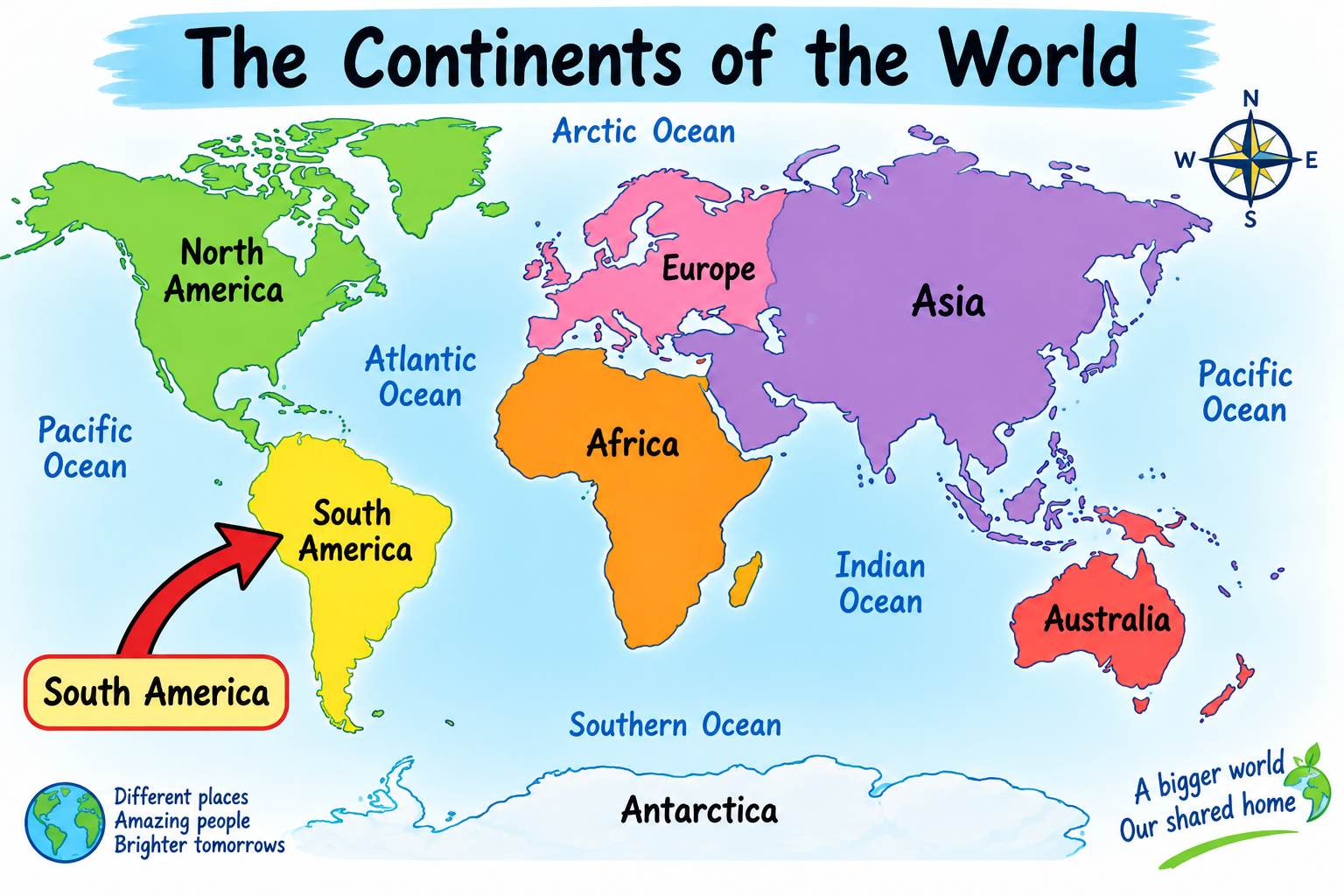
South America is a continent made up of 12 countries. We will be locating each one on a map, finding their capital cities, and comparing facts such as population, currency and flags.
The 12 countries of South America are: Argentina, Bolivia, Brazil, Chile, Colombia, Ecuador, Guyana, Paraguay, Peru, Suriname, Uruguay and Venezuela.
Physical Features of South America
We will be researching and mapping four spectacular physical features found across the continent:
The Amazon River
One of the longest rivers in the world, flowing through the heart of the rainforest.
The Andes
The longest mountain range in the world, stretching down the western edge of the continent.
The Pampas
Vast, flat grasslands found in the south-east, used for farming and cattle.
Angel Falls
The world's tallest uninterrupted waterfall, found in Venezuela.
Focus On: Brazil
Brazil is the largest country in South America — and it is packed with human and physical features for us to explore:
Human features: Brazil's official language is Portuguese, its currency is the Brazilian Real, and it is made up of 26 states. We'll find out about its leaders, its cities and its famous landmark, Christ the Redeemer.
Physical features: Brazil has one of the longest coastlines in South America and is home to a huge stretch of the Amazon Rainforest, the Brazilian Plateau and the Pantanal wetlands.
Time zones: South America spans five different time zones — we'll investigate why such a large continent needs so many!
Making a Difference
As part of our topic, we'll be learning about organisations such as Street Child United, who work to support children in Brazil, and reflecting on this through poetry and persuasive writing in English.
Key Vocabulary
Here are some important words we'll be using this term. Can you learn them all?
Continent Country Capital city Population Amazon River The Andes The Pampas Rainforest Portuguese Time zone Human features Physical features
Across the Curriculum
Our South America topic links to learning right across the curriculum:
Geography
Locating countries, capital cities and physical features
English
Fact files, poetry and persuasive writing
Maths
Time zones, distances and data handling
Computing
Using Google Earth to explore South America
Art & DT
Illustrated maps and campaign designs
PSHE & Oracy
Exploring lives of children around the world
How You Can Help at Home
Explore South America on Google Earth together — look for the Amazon River, the Andes and the countries we're learning about.
Watch a documentary about Brazil or the Amazon Rainforest together — a great and fun way to pick up extra knowledge!
Ask your child the key vocabulary words above — can they name all 12 countries of South America?